
digital transformation and integration modeling
Organization
The client is a leading real estate services company with over 2,700 locations across the U.S. and operations in more than 80 countries. They serve a diverse customer base, including home buyers, sellers, brokers, lenders, and agents. Their comprehensive range of services includes Residential and Commercial Title Insurance, Escrow and Settlement Services, Lender Services, Underwriting, Legal Services, as well as Personal and Commercial Insurance solutions.
Challenge
Over the last decade, the client observed significant shifts in the financial and lending industry, particularly in customer digital interactions aimed at simplifying decision-making and enhancing operational reliability. Recognizing the need for digital transformation, the client aimed to modernize Partner Management, streamline integration services, and improve data management across persistence and presentation layers.
To achieve these goals, they sought a partner with extensive data management expertise to define an integration and data access strategy. This would enable the development of reliable services leveraging legacy assets while planning a phased transition of data over time.
Key Challenges Identified:
- Legacy System Integration: Title Production Systems (TPS), such as AIM+ and ResWare, were integrated point-to-point. Any changes to TPS required updates across all connected applications, creating inefficiencies.
- Manual Processes: The Patriot Search functionality was largely manual, leading to delays in order processing times.
- Partner Management Complexity: Managing partners and maintaining connectivity posed significant challenges.
- Redundant Services: Redundant functionalities arose from services being developed in team silos, making enterprise-level updates cumbersome. The client sought an Enterprise Service Catalog to address this issue.
- Limited Data Accessibility: Frequently used data was only stored in databases, resulting in a poor user experience due to limited accessibility.
The client’s vision was to implement a scalable and efficient architecture that improved operational reliability, enhanced user experience, and streamlined enterprise-wide service management.
The Client’s Architecture Before XTIVIA’s Solution
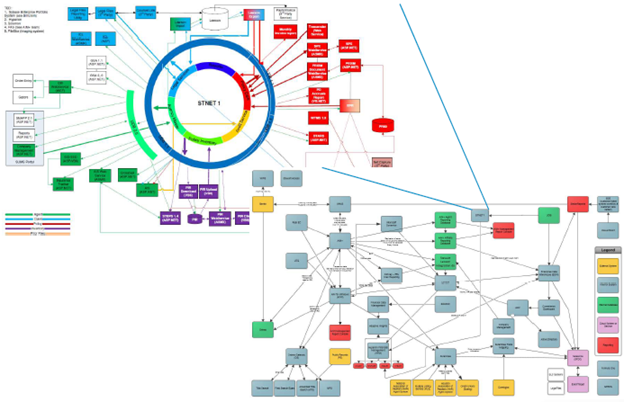 Before XTIVIA’s involvement, the client’s architecture was inundated with point-to-point integrations, making any alteration to the system complicated and time-consuming. Additionally, various redundancies and islands of automation not only hindered functionality but made system updates and maintaining partner connectivity very difficult.
Solution
XTIVIA developed a comprehensive integration strategy to enable seamless interactions with internal applications and external partners (A2A and B2B). Leveraging our expertise in SoftwareAG webMethods, we delivered integration models for various use cases and implemented robust frameworks for Logging, Exception Handling, Notification, and Caching.
Key Deliverables:
- Enhanced B2B Transaction Management: Proposed the inclusion of Trading Networks to manage and monitor external partner transactions effectively. This tool provided advanced capabilities in the B2B space, enabling the client to analyze transactions with built-in reporting and supporting rules-driven document processing.
- Enterprise Service Availability: Delivered a strategic solution to make enterprise-specific services accessible via the Service Bus. XTIVIA created a Service Catalog and API portal, allowing teams to discover and consume existing services as APIs. If a required service was unavailable, the solution included a streamlined service lifecycle request process.
- Business Transaction Monitoring: Designed business models in webMethods Insight to enable business users to monitor service-level transactions from a business perspective.
- Optimized Data Retrieval: Recommended and implemented the Terracotta In-Memory Database tool for faster data access. Frequently used data, such as office lists, were cached in memory, reducing database trips and significantly enhancing user experience.
This integration strategy empowered the client with efficient service management, improved transaction monitoring, and enhanced performance, ensuring a scalable and user-friendly system.
Future Architecture:
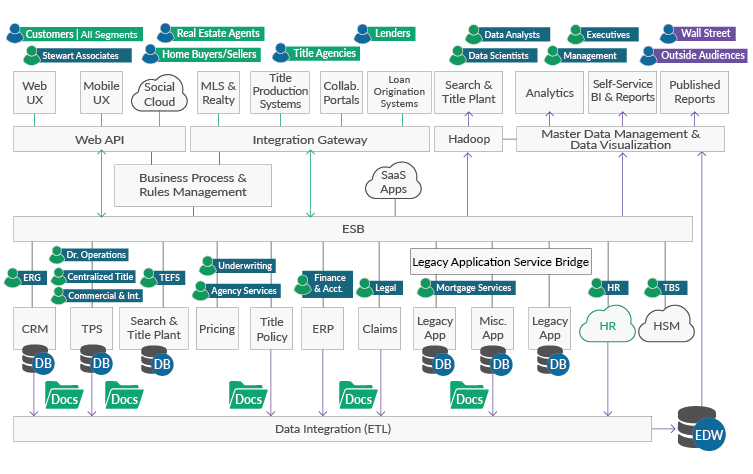 The solution XTIVIA designed for our client encompassed internal connectivity and total B2B functionality. After implementing an integration strategy to interact with internal applications and external partners, tools like SoftwareAG, Trading Networks, and Terracotta allowed us to reinvent the client’s IT infrastructure. Their system can now handle enterprise-level functionality and streamline partner connectivity for enhanced efficiency.
RESULTS
With the implementation of the API plugin in the Encompass portal, our client successfully entered the mid-tier market. They now operate with a centralized team to manage the lifecycle of enterprise-level services, eliminating redundant functionalities. Additionally, all partner contracts, certificates, and processing rules are now centrally managed, streamlining the partner onboarding process for faster and more efficient operations.
KEYWORDS
webMethods Integration Server, Universal Messaging, Enterprise Gateway, API Portal, Terracotta Big Memory, Centrasite, WmInsight
SOFTWARE
webMethods version 9.10 and 10.1, Terracotta BigMemory Max, Universal Messaging
Let's Talk Today!
No obligation, no pressure. We're easy to talk with and you might be surprised at how much you can learn about your project by speaking with our experts.
XTIVIA CORPORATE OFFICE
304 South 8th Street, Suite 201
Colorado Springs, CO 80905 USA
Additional offices in New York, New Jersey, Texas, Virginia, and Hyderabad, India.
USA toll-free: 888-685-3101, ext. 2
International: +1 719-685-3100, ext. 2
Fax: +1 719-685-3400
XTIVIA needs the contact information you provide to us to contact you about our products and services. You may unsubscribe from these communications at anytime, read our Privacy Policy here.